Author: admin_rhoda

About admin_rhoda

A passionate garden designer offering: a complete garden design service, planting designs or garden advice. Based in West London, I work on landscaping and design projects in London, Middlesex, Hertfordshire, Buckinghamshire and Surrey. My portfolio of work includes a wide range of garden designs from contemporary courtyards to large country estates.

What to do/best plants-June

To find out more about the ten best plants for June and all the jobs you can be doing in the garden in June read on:

June 21 is the longest day of the year, and the extra light and warmth encourages the garden to put on an exuberant burst of growth. But this extra light and warmth also means weeds will sprout up from seemingly nowhere. Keep on top of them by hoeing regularly in dry conditions.

Other June Jobs:
– Keep newly planted trees and shrubs well watered whilst they establish.
– Pinch out the tips of your Fuchsias to encourage a bushy habit and more flowers.
– Plant out Summer bedding for that extra colour
– Stake tall or floppy plants
– Mow lawns at least once or twice a week
– Remember to sit and enjoy your garden

For ten of the best plants for June read more below. Or to read about jobs to do in other months or best plants for other months, click here.
Ten best plants for June

What to do/best plants-May

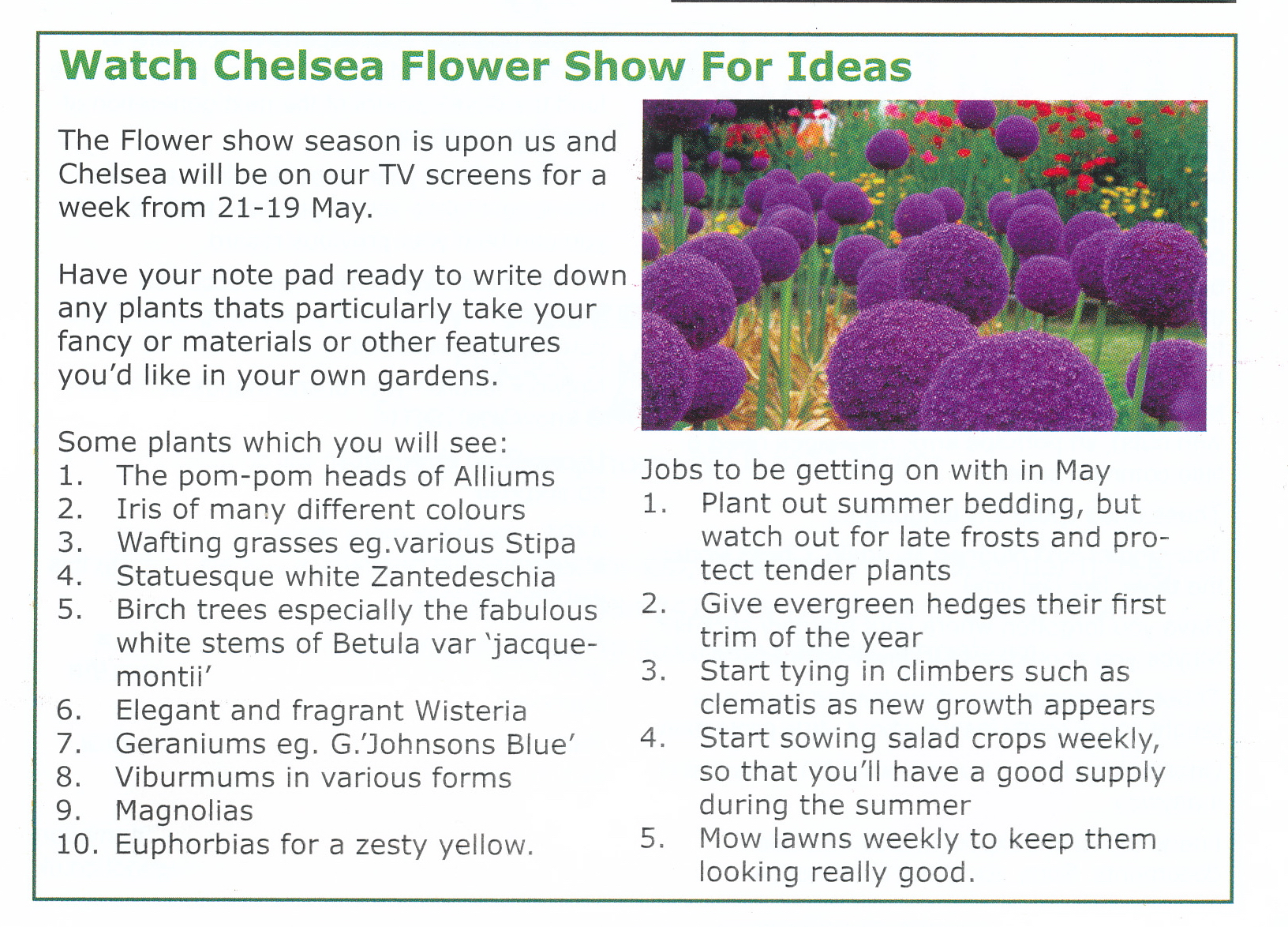
For a list of garden jobs to do in May read on – but also do look at TV Programmes or better still visit shows like the Chelsea Flower Show which will give you ideas for design, features and plants that you may not have previously considered.

Some plants which you will see:
1 The pom-pom heads of Alliums
2 Iris of many different colours
3 Wafting grasses eg.various Stipa
4 Statuesque white Zantedeschia
5 Birch trees especially the fabulous white stems of Betula var ‘jacquemontii’
6 Elegant and fragrant Wisteria
7 Geraniums eg. G.’Johnsons Blue’
8 Viburmums in various forms
9 Magnolias
10 Euphorbias for a zesty yellow.

See below the full article which also tells you of jobs you could do in the garden now. Or to read about jobs to do in other months or best plants for other months, click here.
Jobs to do in May

what to do/best plants-April

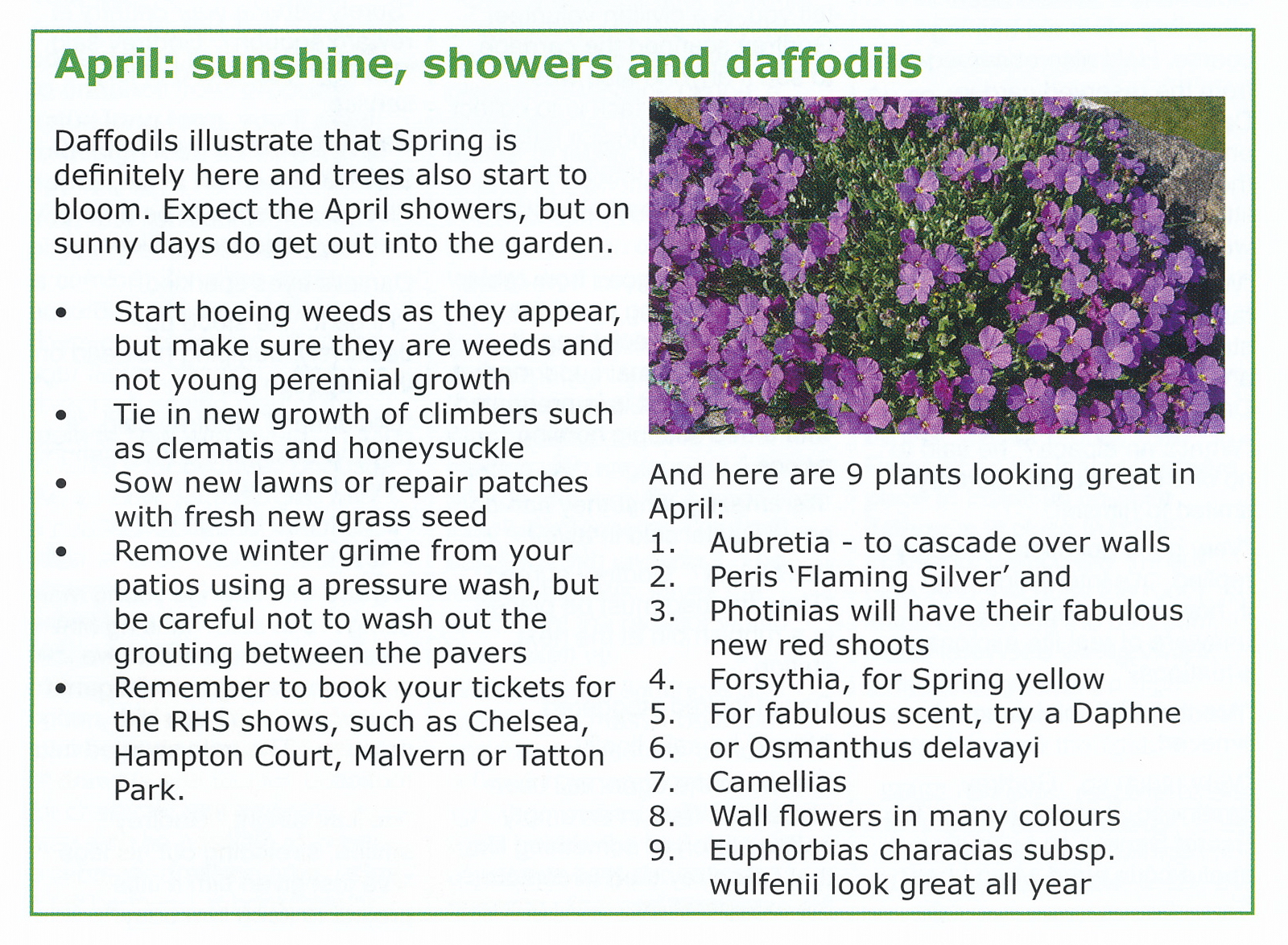
Daffodils illustrate that Spring is definitely here and trees also start to bloom. Expect the April showers, but on sunny days do get out into the garden.

1 Start hoeing weeds as they appear, but make sure they are weeds and not young perennial growth
2 Tie in new growth of climbers such as clematis and honeysuckle
3 Sow new lawns or repair patches with fresh new grass seed
4 Remove winter grime from yourpatios using a pressure wash, but be careful not to wash out the grouting between the pavers
5 Remember to book your tickets for the RHS shows, such as Chelsea, Hampton Court, Malvern or Tatton Park.

And here are 5 plants looking great in April:
1 Aubretia – to cascade over walls
2 Peris ‘Flaming Silver’ and
4 Photinias will have their fabulous new red shoots
5 Forsythia, for Spring yellow

For the full article about jobs to do in the garden and more plants looking great in April. Please see below and for jobs to do in the garden other months please click here.
Plants looking good in April

what to do/best plants-March

Some of the best plants for March are:
1 Akebia quinata – a climber with a chocolate scent
2 Bergenias in Pinks or whites
3 Various Chaenomeles (flowering quince) but mind their thorns
4 The amazing contorted stems of Corylus avellana ‘Contorta’ or the more unusual Corylus avellana ‘Contorta’ with pink catkins and bronze leaves
5 Nothing can beat the scent of Daphne odora ‘Aureomarginata’.

Some jobs to do in March:
1 Protect new spring shoots from slugs
2 Plant summer-flowering bulbs
3 Top dress containers with fresh compost to add nutrients
4 Cut back Cornus (dogwood) and Salix (willow) grown for colourful winter stems
5 Weeds will be growing well, so deal with them before they get out of hand

To see the full article with advice on what to do in the Garden in March and plants looking great in March, please below To read what to do at other times of the year click here.

Best plants for March


What to do/best plants-February

What to do in the Garden in February.

Winter has been a good excuse to stay in the warm and not venture outside. However, depending on how cold or warm it’s been, plants will be stirring themselves to perform later in the year, so there are jobs to help them on their way:
– Deadhead and prune any of your winter flowering shrubs and hardier plants, such as Wisteria, Roses, Clematis, Grape Vines.
– Finish winter pruning fruit trees and soft fruits such as Apples, Pears, Currants and Gooseberries
– Plan any changes you want to make eg. new borders to create, different plants or annuals to add, so that
you’re ready to plant when it warms up

Some plants looking great in Feb
– Lots of Heathers, but be careful, most need acid soil
– Jasminum nudiflorum and Forsythia will bring bright yellow cheer to the garden
– Daphne odora ‘Aureomarginata’  will give fabulous scent, as will any of the Witchhazels (Hamamelis)

To read the full article, please see below, or to read about what to do other months click hereIn the Garden in February

What to do/best plants-January

What to do in the Garden now?

If you don’t fancy being outside and digging that heavy soil (which is actually a good idea in winter!) Now is a good time to order seed catalogues, to select next year’s bedding and perennial choices. You have more chance of finding everything you want if you order well before the spring.

Plants looking great in January:
1 Clematis cirrhosa var.purpurascens ‘Freckles’
2 Mahonia × media ‘Charity’
3 Sarcococcas
4 Winter pansies for vibrant colour
5 Garrya elliptica for interesting hanging tassels of flowers
6 Many Viburnums eg: Viburnum tinus ‘Lisa Rose’
7 Many Helleborus (the ‘Christmas Rose’)

Scroll down to see full Article and to read what to do other months click here.

2015 – Garden design expert required

Design a space, a contemporary interior design company, were having a ‘Midsummer event’ to celebrate a successful year in their Amersham showroom. Rhoda was asked to come along as their “garden design expert” for the evening; to give a demonstration of how to create and maintain successful pots in the garden and for anyone who wanted a garden consultation or some general gardening advice.

It was a lovely sunny, summer evening that was thoroughly enjoyed by all.

To see what Design a Space could do for you please visit:
http://www.designaspace.co.uk/

Also have a look at our guide to planting pots

2014-2019 – Perennial meadow: Seed vs Turf

Rhoda Maw offers professional planting advice, often gained from personal experience. Like here, where I had previously really enjoyed my meadow of all Annual seeds, I thought I’d try a Perennial meadow.

There is lots of discussion about Seed verses Turf, so I thought I’d do a trial in my own garden to see how they compare. Have a look and see what you think.

Turf laid and seeds sown early December 2014 (would have been better in Oct or November, which may have made a difference). The weather had been mild and wet, but there had been some frosty nights, so they most probably were both hit straight away with the cold.

Click below to see how the meadows compare
Seed Vs Turf Perennial Meadow comparison

2014 – Chelsea Flower Show

Rhoda offers garden design help to anyone who asks. This year she worked at Chelsea again on Hugo Bugg’s Gold-medal-winning, Main Avenue garden; one of only 6 show gardens that were awarded gold this year.

This was a great garden illustrating how you can create an interesting design while managing water responsibly in a garden. Water doesn’t have to run-off all the hard surfaces and go straight down the drain or cause flooding, it can go through a series of ponds and filtering systems to ensure that it is used by the plants and filters into the soil and only then does any overflow or excess finally go down a drain.

See the RHS Website for further information:

2014 – Annual seed meadow

Meadows in gardens are definitely popular at the moment. Garden designers are using them in their Chelsea and Hampton Court show gardens and even local Councils using them as an alternative to costly bedding plants on the sides of roads and in parks and gardens.

Therefore I wanted to see how an annual meadow seed mix would work on a small scale in a domestic garden. Look at the link below to see how the meadow progresses throughout the year, starting in March where lawn was removed, soil dug over and what seemed like a tiny amount of seed scattered.

By June the first flowers appeared, then July was a riot of colour with red poppies shining through. There was still colour well into Autumn with even some yellow and white glowing in the winter months.  But then the winter frosts killed it all off.

Annual meadow mix progress:

The downside is that if you want colour again the next year you have to dig this all up and sow seeds again, which is why I trialled a Perennial meadow.